
Starting Slow, On Purpose: What Your Dog's First Weeks With Us Really Look Like
Starting something new with your dog can stir up a lot of feelings all at once. There's excitement, the hope that this could be the thing that helps, maybe even the thing you've been searching for. And there's often a quieter feeling underneath that, a little bit of nervousness, or even something closer to fear. You're stepping into the unknown with someone you don't know yet, hoping they'll understand your dog the way you do, wondering if this class is really going to help with the things you've been struggling with, or if it might somehow make things harder. That mix of excitement and uncertainty is so normal, and it's something I think about a lot when I picture someone joining our community and starting classes with us.
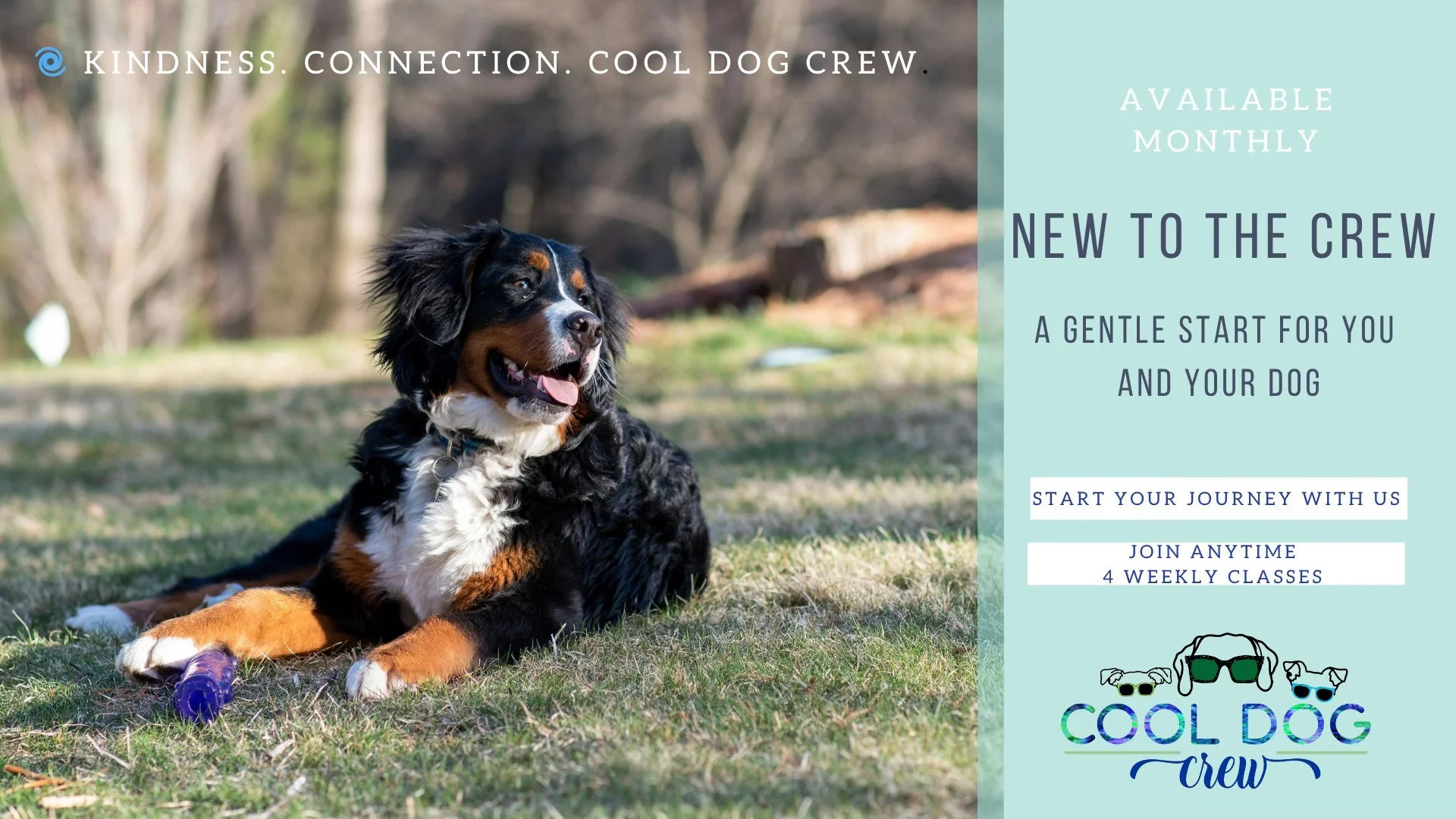
I built our New to the Crew class to be a process, not a single event, one designed to meet that mix of feelings with as much gentleness as possible, for you and for your dog. Here's what that actually looks like, from the very first hello to becoming part of our dog behavior and training community, the Crew.
It starts with a conversation, not a class. Before anything else, we hop on a fifteen minute call together, and that call starts with you. You tell me about your dog first, what's going on, what's been hard, what you're hoping for. Then I share a bit about how I think about training and behavior, and I'm happy to answer any questions you have, whether that's about safety, or about how we'd approach whatever your dog has been struggling with. By the end of that call, we always know what the next step is. There's never a question mark hanging over it, because that next step is simply whatever your dog needs most, nothing more and nothing less. Sometimes that means starting at home first, with a private behavior plan and Zoom sessions before we ever set foot in a group setting. Other times, it means New to the Crew is exactly the right starting point. Either way, we figure it out together, before we even hang up.
If you've been to a class before that didn't sit right, you're not alone, and there's nothing wrong with you for feeling that way. So many people come to me having had a trainer ask them to do something that felt harsh or uncomfortable, or watching their dog seem like a completely different animal in class than they are at home, more shut down, more anxious, more on edge. Sometimes it's simply that the other dogs or people in the class weren't a good match for where your dog was at that moment. Many of us have been there, in classes led by trainers whose methods leaned more toward compliance than compassion. That history matters, and it's part of why New to the Crew exists the way it does.
It's worth saying clearly that this slow start isn't only for the dogs. People feel nervous too, especially carrying experiences like the ones above, or simply not knowing what to expect from a class like this. This process gives you room to settle into it. There's space to ask questions as they come up, space to simply watch before anyone asks you to do anything, and space to let your dog just be a dog, sniffing, scanning, settling in their own way, without needing them to behave any differently than they would on an ordinary walk. Nothing about these early weeks asks more of your dog than what they're already comfortable giving, and nothing about them asks more of you either.
We start with one of two Saturday morning windows, either 8:15-8:45 a.m. or 10:15-10:45 a.m.. These times aren't random. During the 8:15 a.m. slot, before the group class begins, we spend that time together just exploring or possibly learning new games, and talking through any current behavior questions or struggles, building a plan that fits your dog specifically. Once that time is up, your dog gets to settle into a chew or a Kong from a comfortable distance and simply watch the 9am class roll in, taking in all that movement and energy without any pressure to interact. The 10:15 a.m. slot happens after the group class wraps up, which means your dog gets to explore the space and take in all the smells the other dogs left behind, the boundaries, the spots where dogs played and worked and rested. Both of these windows give your dog enormous amounts of information in a totally low pressure way, while you're getting hands on coaching and new games to practice. Dogs learn so much through their noses and their eyes long before they ever need to learn through direct interaction, and this lets that happen first. Which window we start with, and how quickly things shift from there, depends entirely on what your dog is telling us.
For dogs who are a bit more unsure, we usually start with the after class option, just smelling the smells with no other dogs around at all. As your dog settles into that and shows us they're comfortable, we can shift to the before class window, where they get to watch the dogs move and arrive and then either observe for a while from a comfortable distance or head out, no contact required. We only move to that next step when your dog tells us they're ready for it. Nobody is rushed through these stages on a schedule. Your dog sets the pace, and we follow it.
This is honestly one of my favorite parts of the whole process, because it takes so much pressure off everyone. If a dog needs three weeks at the after class smell session before they're ready to watch dogs arrive, that's exactly how long we take. If a dog is ready to move through these steps quickly, that's great too. There's no right speed, only the right speed for your dog. And because we're moving in such small steps, if a human makes a mistake, maybe stepping a little closer than the dog wanted, or staying a little too long, we can notice it right away and simply back up. Nothing gets derailed. No one, dog or human, ever gets thrown into something they're not ready for.
While all of this is happening, you and I are also getting to know your dog together in a deeper way. These early weeks are a wonderful time to look at the whole picture, not just behavior in isolation. We talk about how your dog is doing physically, whether there's any itchiness, digestive trouble, stiffness, or signs of discomfort that might be playing a role in what we're seeing. If something seems worth a closer look, I'll often suggest connecting with Dr. Walton at Locust Grove Veterinary Clinic. With your permission, she and I can work together, with me sharing what I'm observing in terms of movement, comfort, and behavior, and her bringing her extensive medical expertise to the table, whether that means physical therapy, massage, a pain medication trial, or further testing. Behavior and physical wellbeing are so deeply connected, and catching something early can make a tremendous difference in how smoothly the rest of this journey goes.
Once your dog is ready to actually join class, distance continues to be our guide. Every dog gets to choose, with our help, how much closeness feels right at first. For some dogs, that means knowing their vehicle is right there as a safe home base they can return to if they need a break. For others, we use a puppy pen as a visual barrier, giving them a sense of separation and pressure release while they get used to being near the group. And for some dogs, what helps most is full employment, meaning a frozen Kong or a long lasting chew that lets them simply exist near the action, enjoying themselves, without needing to engage in the games directly yet. We mix and match these supports based on what your dog shows us they need, and we adjust as they grow more comfortable.
To support you through all of this, you'll get a binder that walks you through New to the Crew's curriculum, complete with directions for each game so you always know what we're working on, why we're working on it, and how to practice it at home. And if you ever want to see a game in motion again, or get a clearer picture of what a foundational skill looks like step by step, my YouTube channel has video walkthroughs of many of these games. You're always welcome to revisit them as many times as you'd like, whenever it's useful for you.
I describe New to the Crew as a four week class because it's a helpful general framework, something to plan around and look forward to. But in practice, it's much more flexible than that sounds. For some dogs and people, four weeks is exactly right. For others, this same gentle process might unfold over two months, or three, or longer, and that is never a sign that anything has gone wrong. It simply means your dog needed more time, and we made sure they had it.
Through all of it, everything we do is guided by two priorities, always in this order. First, we want your dog to feel safe in the environment. Once that foundation is solidly in place, we move on to the second priority, helping your dog feel able to learn in the environment. Trying to get to that second piece before the first one is truly settled rarely works, and honestly, it's part of why so many dogs struggle in more traditional class settings. Here, we take the time to get the order right, because a dog who feels safe is a dog who can learn, grow, and eventually thrive.
By the time a dog is fully part of New to the Crew, they've already learned an enormous amount, not because we drilled it into them, but because we gave them the time and space to discover it for themselves. And you've learned right alongside them, picking up a deeper understanding of dog behavior in general and your own dog in particular, things that will serve you for the rest of your time together.
This is why New to the Crew doesn't feel like a typical first class, because it isn't one. It's a beginning that respects where your dog is starting from, and a process that trusts your dog to show us the way forward.